Showing posts with label torture. Show all posts

7 May 2008

Teach kids to question authority

I just finished reading Cory Doctorow's Little Brother: a very dangerous book to pick up in the late evening. It is a young adult book about teenage hackers who bring down police-state security regime enforced by the U.S. Department of Homeland Security following a terrorist attack and restore the Bill of Rights.

T-shirt: Don't Trust Anyone Over 25Fiction, unfortunately. This is fine reading for young people: exciting, subversive, relevant, and extremely motivating with real-world ideas about things they can do to change the world they live in.

I'm one of Cory Doctorow's 1,000 true fans. The man shames me; he's written the most patriotic book I've read in years – a veritable pæan to the rights and freedoms guaranteed by the U.S. constitution – and he's Canadian. It wasn't easy for me to leave my country of birth, and it is all too tempting to turn my back on it; this book reminds me that the United States once stood for principles worth fighting for, and with work, it could someday again.

The book is available for sale as a dead tree and as a DRM-free audiobook, as well as a freely downloadable CC-licensed text|html|PDF file – and if you downloaded it, liked it, and want him to get paid for it, donate a copy to a library or school.

26 Feb 2008

Naomi Klein connects the dots

I recently picked up Naomi Klein's No Logo – a seminal work by all accounts, and although I tried, I found myself impatiently paging through it, looking for the fresh insight that I had always heard it offered. No LogoAll I saw were things I already knew about the effects of corporatism and globalization, and the negative effects these trends are having on our health and communities. I realized that the reason these concepts didn't seem very interesting was because they have become such an understood part of our culture's understanding of our new economy that it has become completely internalized. If I had read this in 2000 I might have helped trash a Starbucks in Seattle; today it feels like history.

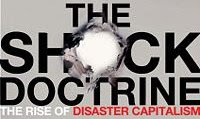
The Shock Doctrine, on the other hand, is very much in touch with the concerns and mystery of the times. Klein explains how the neoliberal/neoconservative revolutions of the past 25 years, from Chile through Iraq, are traced to Milton Friedman's Chicago School. The Shock DoctrineShe explains why governments resort to torture, and long after shock therapy had been thoroughly discredited in psychiatric medicine, it was being applied to economies throughout the world to enable a mass transfer of wealth to the already wealthy elite, undoing the socialist movement of the early 20th century. Klein introduced the concept of disaster capitalism: whenever a disaster strikes (whether accidental or engineered), corporations put plans into operation to raid public treasuries and public trusts while the public is still in a state of shock; she also warns that huge industries have emerged to deal with these catastrophes, and are dependent upon continued disasters for growth. Klein argues that our societies need to become educated to resist this type of manipulation so the next time something bad happens we won't surrender to corporate greed.
Mexican director Alfonso Cuarón produced this short film to introduce the concepts and arguments used in the book.

Ms. Klein's work is having a real impact on our society. No Logo is credited with inspiring the Battle of Seattle; The Shock Doctrine is just beginning to filter into our mass consciousness, and I look forward to the effect it will have on our polity.

20 Nov 2007

Shocking

Defenders of tasers invariably trot out the argument that "tasers save lives." Despite the obvious evidence, they are convinced that in every other scenario they would have used a gun and shot to kill. However, actual data shows that 79% of the time tasers are used on unarmed people.

Of course it is easier to electrocute than to negotiate. [Easy, and fun!] Most of the time it doesn't even kill the person electrocuted; they just become a lot more likely to cooperate with whatever the torturer wants. And the mere threat of electrocution serves other purposes as well. After all, police have never been known to torture or rape people, have they? No, I'm sure that just magically stopped happening in the early 20th century.

A civil society which loses confidence in its police force is in trouble. Right now there is an unfair balance of power: police carry a torture implement for which they cannot really be held accountable. Tasers which merely record the date, time, and duration of an electrocution do not also record the circumstances, the identity of the victim, the location or the reason for doing so. As such, they not only hold potential for abuse, they practically guarantee it, and the evidence is there.

16 Nov 2007

Ban tasers

It has been adequately demonstrated that police cannot be trusted with tasers. They are too dangerous, and police are far too willing to use them. The increasingly common use of these weapons illustrates society's increasing willingness to commit brutal torture.

Now you can watch a snuff film of police killing a distraught man at Vancouver airport with tasers: three officers tasered him seventeen seconds after approaching him, and he died.

It's not just a shame, it is shameful. How can we call ours a civilized society when we permit this?