Showing posts with label capitalism. Show all posts

28 Mar 2012

Second, Third, and Fourth-Order Effects of Social Marketing and Mass Securitization

Several years ago, Facebook founder Mark Zuckerberg crowed that he was able to use the database to retroactively predict with 33% accuracy with whom people would hook up a week later. This was widely viewed as very creepy (and was not spoken about again until recently) but you can guess that this was a dog whistle meant for potential advertisers. The advertisers have listened, and now Google is scrambling to catch up with Facebook on social search (and then advertising).
It’s impossible to get clear numbers on how well this stuff works. Even Facebook and Google probably have no clear numbers, but they certainly have clear enough indications. Google obviously has a clear enough indication to reform their entire company around this. So we can assume it is real. It all seems plausible enough, right?


So we can easily assume that this trend will continue, and that Google and Facebook will correlate increasing amounts of data on us, our friends, our coworkers, and the people we encounter, and will sell this data to advertisers who will essentially be placing bets on our behaviour. If there is a 27% chance that a given couple will marry within the next nine months, then there is a 14% chance that each of their closest long-distance friends will want to buy a plane ticket to the ceremony. Therefore, as an advertiser, you buy a tranche of ads for people whose out-of-town friends are soon to marry. The MapReduce job is an exercise for Google’s new Malaysian coding shop, the tranche is sold to the highest bidder via AdWords. Bada-bing, ca-ching.


As a second-order effect, this advertising activity begins to affect the behaviour of these out-of-town friends. A measurable jump in the number of people attending out-of-town weddings results, and the price on these ads consequently rises. Advertising grows markets all the time, so this is not surprising.


Now we emerge into science fiction-ville. An analyst-bot for a huge trading firm is trawling the AdWords marketplace, looking for interesting tranches for which the price has become overweight, and happens upon the out-of-town weddings advertising market, which is suddenly hugely oversubscribed. It pops up on the screen of a junior analyst (of the human variety) who clicks through to approve the creation of a out-of-town weddings futures market, which the trading firm then (automatically) proceeds to sell to its customers, and then (automatically) takes a short position.
An analyst-bot for one of the advertising agencies flags this new offering, and raises it to the desk of the (human) product manager for this market. She promptly buys into the futures market, betting that the market will rise. She talks to an executive VP and gets approval to buy a large product placement with a popular television show to feature a destination wedding as an upcoming plot. She does not get approval for a proposed contribution to a PAC formed by the National Organization for Marriage, as the VP is gay and cites the growing market for same-sex weddings.


Of course, this assumes that the securitization of everything will continue apace. Certainly there has been no progress in stemming the tide, and I don’t expect it to happen (barring a bloody worldwide insurrection against the dominant economic order).


What are some other examples of the weird things that could result from social marketing combined with this level of financial automation?
  • A new global baby boom triggered by businesses embracing new market development, caused by an algorithmic storm of projected demand for diapers, crude oil, softwood lumber, and manual labour. [The whole thing is triggered by a rounding bug in an Excel spreadsheet.]
  • Investment banks engage in wide-scale manipulation of tampon supply futures indexes by using sponsored advertisements to influence birth control method preferences so that women favour Depo-Provera over oral contraceptives.
  • The Corrections Corporation of America gets into a bidding war with Indian defense contractors on a cheap-labour-supply futures index, which is based on the relative probability of incarceration due to attempted drug sales by American teens.  The Indian defense contractors are shorting this to offset their own risk (due to the effect of rural broadband penetration shortfalls on the gold mining talent pool), and the market becomes very volatile.  To ease this situation, the CCA makes a large automated contribution to a tough-on-crime SuperPAC.
  • Asperger's patients become a new hot dating commodity, as their profiles are moved to the top of the activity ranking by social networks who wish to boost their visibility to advertisers who are bidding extremely highly for their ad dollars.  Social networks optimize their users lives to improve their value to advertisers.  This results in nerds getting laid a whole lot more, and lots more little Asperger's-prone nerdlings (who have truly wonderful advertising potential).
So just remember kids, just because you don't click on those ads in Facebook doesn't mean that those ads aren't clicking on you. And with Google+ and Facebook embedded in every single webpage, you can run, and you can hide, but you cannot avoid being aggregated, and those aggregations will be monetized until they control your every move. Resistance is futile.


Re-reading this hours later I realized that what I'm describing here is a much less rosy portrait of the same technological trends outlined by Bruce Sterling in his seminal short story Maneki Neko back in 1998. Except of course his story has excellent characterization, plot, and narrative drive.

26 Nov 2011

Bankers cautious on Eurozone breakup

While some banks are calling for contingency plans in the case of the breakup of the Eurozone, a large majority of investment banks, hedge fund managers, and responsible commentators are saying "hold on a minute."

"Where am I supposed to put the money?" said Lloyd Blankfein, CEO of Goldman Sachs. "As CEO, I'm committed to maximizing corporate profits, and while Goldman Sachs will obviously make bank on this one that will make the real estate bubble look like a pinprick, I personally haven't even figured out what to do with my bonus from that yet."

Most economists agree that a breakup of the Eurozone would mean an immense realignment of riches, and complain that the term "percent" is becoming particularly unwieldy in describing the distribution of wealth. "My friends and I can't even explain how rich we are anymore. Saying 'We're the 0.00001%' is too hard to understand," lamented hedge-fund manager Peter Thiel. U.S. lawmakers are studying proposals for mandating use of a new term "permega", in which percentages would be replaced by fractions based on a million, as part of the recently introduced Division Is So Hard (DISH) Act.

Tax experts welcome the possibility of change, saying that they are running out of zeros when expressing tax liability to their clients. "You need to pay 0.0000001% of your income in tax this year" is just too hard for many of my esteemed colleagues to follow, said H&R Block CEO William Cobb. "Keep in mind, most investment bankers have graduated in the past 5-10 years from top educational institutions in the United States, and although they all got straight As and graduated at the tops of their classes, so did everyone else."

Although momentum has been significant on the DISH act, with ten co-sponsors in the Senate, opposition is growing. Senator Chuck Schumer (D-NY) is leading the charge against such a change, arguing that math isn't the problem and the tax code itself is at fault. "We can't keep applying the same logic, putting another zero in front of the tax burden of our nation's most productive workers. My smartest staffers tell me that by simply putting a minus sign in front of the tax rate we could reverse the trend and start getting those numbers under control, especially for workers in the affected brackets. We wouldn't have to invent a new symbol, either."

Notwithstanding these efforts by legislators to soften the blow, plans are proceeding apace to launch new currencies in place of the Euro. "We're still trying to work out how we can absorb all of the wealth of the Euro, as well as all of the wealth in the new currencies that will be introduced," said Mr. Blankfein. "We applaud the efforts of our friends in European governments to include us in discussions on how to build a variety of efficient banking systems that will benefit world economic growth."

However, Mr. Blankfein sounded a note of caution on current U.S. legislative efforts to ease the transition. "Of course we appreciate all of the help we can get, but right now that's up to the European Union. The U.S. government should stay focused on efforts to finance the next round of bailouts."

28 Sept 2008

No bailout is big enough to solve the credit crunch

Portraying the credit crunch as a strange anomaly that can be cured by writing a trillion-dollar cheque is extremely naïve and unrealistic.

The United States and its citizens are carrying an unprecedented and unsustainable debt load. Thanks to the neocon regime of the past twenty-eight years (yes, you too, Mr. "3rd Way") which hobbled the government, and the klepto-corporatist administration still in office (and up for a third term) which raided the wealth of the nation to hand over to oil and military contractors (and now financial firms), the United States is so far overextended that the entire world is collectively cutting it off from further credit.

Danger! Cliff!Just as banks are suddenly thinking, "hey waitasecond, maybe we shouldn't hand out credit cards like party favours", and "maybe we should check to see whether the collateral on a loan actually exists", investors and central banks of other nations are suddenly thinking, "hmmm, the United States has a seemingly infinite trade deficit and doesn't seem to produce anything of value but porn", "I wonder what, if anything, backs T-bills these days", and finally "It doesn't seem that the US military is going to be pushing anybody else around anytime soon."

The bailout is supposed to remove toxic mortgages from the balance sheets of large financial firms, and that is supposed to magically cause the credit to flow again. Wrong. What happened with the subprime loan mess is that it eventually woke everybody up to the fact that the US is at the end of its empire, and extending it credit no longer makes any sense. The US and its citizens can't afford any more debt, and they aren't going to be allowed any more. The party's over, the keg is all tapped out, and this hangover is going to be long and difficult, with vomiting, nausea, and no more drinks for a long, long time.

Bush waves goodbyeThere's not enough money in the collective assets of the United States at this point to buy a hair-of-the-dog large enough to make a difference. The US has declining human capital in every measurable way, it has a tarnished reputation, and the valuable raw natural resources now lie chiefly in other countries. This bailout is just a parting shot, a payoff to the powers who bought and paid for this administration, and a fond final farewell snatch from the taxpayers who made the whole show possible.

A thoughtful letter on the bailout from Rep. David Obey (D-WI-7th)

I wrote a note to Representative David Obey of the 7th district in Wisconsin. He wrote this very thoughtful and honest reply, which seemed refreshingly free of bullshit. Obviously he's going to vote for the bill, but he avoids the condescension, evasion, misdirection, and outright prevarication of shitheels like Isakson. Hopefully after Obama takes office in January we will see reversal of that indefensible bankruptcy bill and finally see some more meaningful reform. What the hell, maybe we'll get another New Deal. It's about time.

September 27, 2008

Dear Mr. LeDuc:

Thank you for contacting me about the President’s request for a massive $700 billion bailout of the financial markets.

As you might expect, I have heard from many, many people who are unhappy, fearful, and frustrated by what has been going on, and the vast majority are staunchly opposed to the President’s proposal for what is, in effect, a blank check. I am, too, and let me make it perfectly clear that I have no intention of giving this, or any other President, a blank check to do with as he wishes. We've seen that before when the President demanded that Congress give him a blank check for Iraq - with disastrous consequences.

We are currently paying a huge price for the fact that for over 20 years we’ve had massive deregulation of the financial sector of our economy and, at the same time, economic policies that have favored the top dogs at the expense of everybody else.

If you take all of the income growth that has occurred in this country in the last eight years and see who got it, over 95 percent of all of the income growth in the country went to the wealthiest 10 percent of families. That means 90 percent of American families – 9 out of 10 – were left to struggle to get a piece of just 4.7 percent of the total income growth that’s occurred in the last eight years.

As a result, people who, in real terms, have had their income frozen for nearly a decade have tried to keep their heads above water by borrowing. In fact, over the last eight years, mortgage debt alone has gone up by $7 trillion, almost seven times as much as the national debt that we hear so much about.

And with the umpire off the field because of the relentless drive for less regulation by the Reagan and Bush Administrations, and on occasion the Clinton Administration as well, many on Wall Street who were looking for a way to make a bigger buck than ever have made the problem worse.

I fought that pressure time and time again.

For example, I was one of 57 members in the House who opposed the repeal of the Glass-Steagall Act, which was enacted during the FDR Administration. Glass-Steagall was enacted to keep investment banking and community banking separate, because they didn't want the high-flying, risk-taking actions of investment bankers to infect the community banking system. It stood us in good stead for generations. During debate on the House Floor during the vote to repeal Glass-Steagall, I said that the bill was:
"consumer fraud masquerading as financial reform. There is nothing wrong with modernizing financial institutions. It is nice to see that my colleagues are going to try to set up one-stop shopping services for financial services. But returning 1999 to 1929 is not reform in my book.”
At this point, we don’t know what will be negotiated with the White House, but we do know that they have the Congress over a barrel because if we don't do something credit markets are likely to freeze up. It doesn't just mean that Wall Street is going to be crippled; the people who will be left holding the bag are American families. The impact on Wall Street will have trickle down consequences for every family in America, and if Main Street business can't get credit, there could be thousands of businesses that go under and we could have the worst economic mess since the Great Depression. So something has to be done.

As Franklin Roosevelt said in his inaugural address in 1932 when he was facing a similar collapse of the financial sector of the economy, "we need action and now." We must provide that action at the same time we make every effort to build in assurances that protect American taxpayers.

Middle income families have missed out on the production of wealth in recent years and taxpayers have been ripped off with giveaways to the wealthy and well-connected, paid for by ballooning the deficit and passing the costs onto future generations.

We’re looking for a number of changes to the Administration’s proposal to protect the taxpayer’s interest.

First, we are trying to ensure that the taxpayer will get the benefit of any recovery in the value of the assets the government would buy from financial institutions.

Second, we are trying to find a mechanism by which Wall Street can pay a significant share of the tab so taxpayers don't get stuck with the whole load.

Third, there needs to be an independent review board looking over the shoulder of the Fed as it makes financial decisions to blow the whistle if problems develop.

Fourth, there certainly should be limitations on compensation to the executives of the companies receiving federal aid and no golden parachutes.

Fifth, there needs to be a reinvigoration of oversight by regulatory agencies to prevent this from happening again.

And that’s just scratching the surface. There are a number of other things that need to be done, too.

I also hope we’ll see a change in the bankruptcy law passed, over my objection, by the last Congress, which did not take into account that some people are unable to make their mortgage payments or credit card payments simply because they’d either lost their jobs or had a health problem. Certainly we ought to be able to provide some sort of relief for people in that kind of situation, so that people on Main Street are getting the same sort of considerations as the big shots on Wall Street.

You should also know that, as I write this letter, Congress is considering legislation that I authored to try to help people on Main Street who are suffering because of this crisis. We're trying to make greater investments in the country's infrastructure by beefing up our sewer and water construction and highway and airport construction in order to create a good number of well paying private sector jobs. We also want to extend unemployment insurance to help address the fact that 600,000 Americans have lost their jobs this year. And we are also trying to provide some budget support for states so they do not wind up knocking poor children off health care rolls.

Please be assured that, as we move forward to confront this challenge, the needs of taxpayers, homeowners, and working Americans and their families will be uppermost in my mind.

Thank you again for taking the time to get in touch.

Sincerely,
David Obey
Your Congressman

25 Sept 2008

Johnny Isakson lies about the bailout

I just got this email reply today, 25 September 2008, from Johnny Isakson, senior senator from Georgia. The coward hasn't put it on his website, so here it is.

Dear Mr. LeDuc

Thank you for your letter regarding the economy, the financial markets and the proposal from the Treasury Secretary to the Congress.

We are in difficult financial times, and I am committed to protecting the savings and jobs of the people of Georgia by making sound decisions on both immediate actions as well as long-term actions.

First, our economic stress is rooted in the decline of the housing market. The cause of the decline was the funding of marginal credit mortgages (subprime) through the creation of mortgage-backed securities that were sold around the world. As the default and foreclosure rate on these mortgages increased, the value of the securities declined. As the values declined, the balance sheet of the financial institutions that bought them deteriorated. The market for these securities declined and ultimately evaporated, thus causing a liquidity problem for the financial institutions and a credit crisis for American consumers and small businesses.

In the immediate term, we must address the credit and liquidity crisis. In the long term, we must put in place the oversight and safeguards to ensure the transparency and accountability necessary to prevent this from happening again. The Treasury has proposed using up to $700 billion dollars to purchase, at a discount, these mortgage-backed securities. This would provide liquidity to the financial institutions and improve their balance sheets. The important question is this: "Is the taxpayer of Georgia protected?" If the Treasury properly discounts the securities to, say, 50 or 60 cents on the dollar, and holds the securities to maturity there should be little or no cost to the Treasury. More importantly, investors will return to the market and will compete with the Treasury to by these discounted securities and the market will be reestablished. I am working to ensure the safeguards necessary for maximum security for the taxpayer.

In the long term, we must bring transparency and accountability to Wall Street. While I am not a big government regulator, if the investment bankers on Wall Street were held to the same standards of transparency and accountability as our national banking system, this would not have happened. The security rating agencies such as Moody's and Standard and Poor also share some of the blame for the way they rated the subprime mortgage-backed securities, and they should be held accountable. I will work hard for the right reform of Wall Street.

The term bailout has been used a lot in this debate. Not a dollar of the $700 billion will go to the brokers who created the securities. Instead, they will go to the investors who bought them, and then only after they take a significant discount or loss. Properly executed, the Secretary of the Treasury and the Chairman of the Federal Reserve believe this proposal will restore liquidity to the credit markets and return confidence in the financial system.

I will continue to work for the best interest of our economy and the safety of the savings of the citizens of Georgia.

Thank you again for contacting me. Please visit my webpage at http://isakson.senate.gov/

for more information on the issues important to you and to sign up for my e-newsletter by choosing
Newsletter Subscription from the topic list.


Sincerely,
Johnny Isakson
United States Senator

For future correspondence with my office, please visit my web site at

http://isakson.senate.gov/contact.cfm
.
You can also sign up for the
eNewsletter by choosing Newsletter Subscription from the topic list.


My reply:

I am in receipt of your condescending and misleading letter concerning the Wall Street bailout.

Don't try to confuse the issue with me, sonny. Tax money going into a private balance sheet is a bailout. Businesses making threats that if they don't get blood money they'll take down the economy is called a shakedown. If you vote for this bill, you'll be making a choice which side you're on: corporations instead of citizens. And there will be consequences.

Count on it.
Now don't make a liar of me. Let's make these bastards pay.

Not one god-damned red cent for Wall Street

I'm just as deep in the stock market as anyone else is these days. After all, government policy has been urging employers to gut pension plans (remember guaranteed retirement benefits?) in favour of investment plans (with only a set contribution, but no guaranteed returns). So most of my retirement savings is tied up in the stock market, which is a risky gamble. I could lose it, but I wanted the big payoffs that stocks might provide, so I took a chance.

That's how the free market is supposed to work, right? Isn't that what Nobel-prize winner Milton Friedman said? Isn't that the ideology which has been ascendant in the US for the past twenty-eight years? If the banking industry isn't working miracles with all of those fantastic new financial instruments they've cooked up, and are in fact just building an elaborate confection that is collapsing on itself, why should we prop it up? It sounds like a huge proportion of the finance industry is doing things of no real economic value. They need a huge handout (plenty of which they'll pass back as "campaign contributions"), and if we give it they'll demand another huge handout in a year after they waste this one.

So fine, let my portfolio lose seventy-five percent of its value. Even ninety-five percent – we'll work it out. I'd rather spend a trillion dollars helping people in need than wasting it on more empty suits. Recessions are necessary: endlessly trying to apply the juice to extend a boom just makes the crash that much harder, and that's what we're seeing now. So let it go, and then we'll work out a more relevant (and possibly even less corrupt) financial system.

Bush said today the sky is falling so we've got to unlock the US Treasury with no questions asked and no accountability. He's the same guy that wanted to gut Social Security and put it all in the stock market! (Wow, too bad we didn't get to experience all of that great growth, huh?) First, we had to surrender all of our civil liberties because the terrorists were going to kill us all with box cutters. Second, we had to invade another country because they were going to nuke our balls. Now we're supposed to give an enormous birthday present to Wall Street because they blew our money on bear whores and cocaine. The man has no credibility. Fool me thrice: go fuck yourself.

Giving a huge payoff to this gang of crooks won't do a damned bit of good; it just encourages them to do it again. Write your senators and representative and tell them no. Maybe some regulation is in order. Maybe the banks need to be nationalized. Maybe mortgages need to be refinanced en masse. Maybe some depositors are going to lose their money (me included). So be it: when there is hell to pay, I'll pay it, but I won't pay one god-damned red cent in protection money.

19 May 2008

Economics and untested assumptions

Plenty of crow is being eaten over hyperbolic statements made about the real estate market. Unfortunately, that crow is being served up to the taxpayers of the US, and people who own US dollars – the companies who stole the money are keeping it. But that is all water under the bridge, of course, because it was all just a big misunderstanding, right? They didn't mean to commit endless fraud. They were just doing their jobs.

Yes, the conventional wisdom of 2005 sounds screwy when we look at it in retrospect. But what other whoppers are we swallowing for no good reason? Compare and contrast these two statements:
“An invaluable book . . . Today’s real estate markets are booming and Lereah makes a convincing case for why the real estate expansion will continue into the next decade. This book should prove to be a truly practical guide for any household looking to create wealth in real estate.” —DEWEY DAANE, FORMER GOVERNOR OF THE FEDERAL RESERVE BOARD OF GOVERNORS

Review for Why the Real Estate Boom Will Not Bust - And How You Can Profit from It: How to Build Wealth in Today's Expanding Real Estate Market, by David Lereah (Chief Economist for the National Association of Realtors), published 2006-02-21

"Suddenly those US government treasury bonds, still near the historic lows of one and two percent, are beautifully attractive because they are safe: they will never blow up like sub-prime CDOs did."

This American Life #355: The Giant Pool of Money, 2008-05-09 (mp3)

Just as nobody could conceive of the US housing market imploding like a cheap lightbulb, nobody can conceive of the US treasury doing the same. After all, it has never crashed, the US has never become insolvent, and therefore it cannot happen.

Except it can.
Foreign investors had simply not appeared, the demand for Uncle Sam's offering--so often a sure-fire thing--had fallen flat. Unlike anytime previously, the world's treasury buyers had suddenly decided to keep their hands in their pockets, invest their oil dollars elsewhere; some in the new-kid-on-the-block euro treasuries, others in their own local currencies.

The great US treasury bond sale: but nobody showed up The Middle East December 2004, by Milan Vesely

All it takes is a crisis of confidence. It doesn't even really require that the US screw up its fiscal situation so badly that the current accounts deficit gets permanently out of whack and stays that way for a generation (oh, never mind, it already has). All it takes is for the Chinese treasury to decide that it no longer wants to finance hip replacements or another US military adventure, and the whole thing could come apart like a piñata.

So, when somebody says with great certitude that an investment is completely safe, hold on to your wallet. That goes double for any government, and twice over again for corporate or state-sponsored media.

26 Feb 2008

Naomi Klein connects the dots

I recently picked up Naomi Klein's No Logo – a seminal work by all accounts, and although I tried, I found myself impatiently paging through it, looking for the fresh insight that I had always heard it offered. No LogoAll I saw were things I already knew about the effects of corporatism and globalization, and the negative effects these trends are having on our health and communities. I realized that the reason these concepts didn't seem very interesting was because they have become such an understood part of our culture's understanding of our new economy that it has become completely internalized. If I had read this in 2000 I might have helped trash a Starbucks in Seattle; today it feels like history.

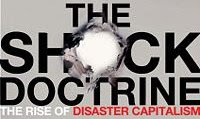
The Shock Doctrine, on the other hand, is very much in touch with the concerns and mystery of the times. Klein explains how the neoliberal/neoconservative revolutions of the past 25 years, from Chile through Iraq, are traced to Milton Friedman's Chicago School. The Shock DoctrineShe explains why governments resort to torture, and long after shock therapy had been thoroughly discredited in psychiatric medicine, it was being applied to economies throughout the world to enable a mass transfer of wealth to the already wealthy elite, undoing the socialist movement of the early 20th century. Klein introduced the concept of disaster capitalism: whenever a disaster strikes (whether accidental or engineered), corporations put plans into operation to raid public treasuries and public trusts while the public is still in a state of shock; she also warns that huge industries have emerged to deal with these catastrophes, and are dependent upon continued disasters for growth. Klein argues that our societies need to become educated to resist this type of manipulation so the next time something bad happens we won't surrender to corporate greed.

Mexican director Alfonso Cuarón produced this short film to introduce the concepts and arguments used in the book.

Ms. Klein's work is having a real impact on our society. No Logo is credited with inspiring the Battle of Seattle; The Shock Doctrine is just beginning to filter into our mass consciousness, and I look forward to the effect it will have on our polity.

20 Feb 2008

Why is this man smiling?

Richard M. StallmanHe is smiling because he is winning. His vision for free software is taking serious hold. It is possible to live a productive digital life using only free software, and I pretty much do (damned "free" Flash player).

When he wrote "the prospect of charging money for software was a crime against humanity" at first I thought it was just baseless, humourous hyperbole, but upon reflection I came up with a different perspective on it. Software allows for automation. Human effort is expended to create software to solve a particular problem, and the human is compensated for that. But should the method for achieving that result become "property"? And whose "property" will it be? Almost certainly, that "property" will belong to a corporation. And corporations are not human. They are legal "people" (emancipated by the U.S. Supreme Court) but they are immortal, amoral, and their true role in our society is incompletely understood. Without the mechanisms provided through free software, and because of the structure of copyright (dictated by corporations), that "property" will almost certainly not be made available to anyone but other corporations able to pay for it. Being immortal, they enjoy many advantages humans do not, and humans cannot reasonably compete in certain areas.

Stallman is a clever guy. He figured out how to do a jiu-jitsu move on copyright to give people an economic model to put software in the hands of other people and organizations (yes, even other corporations). He invented copyleft, a way of enforcing the continued sharing of software, and did it in such a way that corporations couldn't cut it down without sawing off their own arms: copyleft is based on copyright. Without his invention, there would be no practical alternatives to corporate tools made by corporate tools.

10 Dec 2006

LinkedIn

LinkedIn
This was recommended to me today, and I was somewhat dubious. Ah, another Friendster clone, I thought. Well, yes, in fact, it is -- but built for business. This is the sort of thing that, if done right, could wipe out ACT! and take over the contact management market. Hell, if it synced to my cell phones I'd even shell out actual money for it. What really surprised me was that in my first pass through my address book 34 people I knew were already members. Some of them actually even seem to have used it (though there were only about 8 of them with more than 2 contacts). An old friend even found me, though he has ~400 contacts and probably takes it pretty seriously.