Years ago I registered several domain names. They were a lot cheaper then, and because I didn't want to think about which registrar to use, I went with the cheapest and most popular one: GoDaddy.
I did it despite their stupid, vaguely patriarchal name. I did it even despite the blatantly sexist advertisements. I told myself that they were just doing what they had to do to bring in customers, that it really didn't matter. I silenced my doubts and gave them my money.
Since then, GoDaddy's behaviour has been increasingly tacky, insulting, and just plain bad for the Internet and its users. I'm moving all of my domains onto another registrar, and although it is a pain in the neck, it's the right thing to do. The lesson for me is that taste matters. If a company seems distasteful to you initially, they're likely to offend you later — and they'll be doing it with your money.
Showing posts with label advertising. Show all posts
Showing posts with label advertising. Show all posts


28 Mar 2012
Second, Third, and Fourth-Order Effects of Social Marketing and Mass Securitization
Several years ago, Facebook founder Mark Zuckerberg crowed that he was able to use the database to retroactively predict with 33% accuracy with whom people would hook up a week later. This was widely viewed as very creepy (and was not spoken about again until recently) but you can guess that this was a dog whistle meant for potential advertisers. The advertisers have listened, and now Google is scrambling to catch up with Facebook on social search (and then advertising).
It’s impossible to get clear numbers on how well this stuff works. Even Facebook and Google probably have no clear numbers, but they certainly have clear enough indications. Google obviously has a clear enough indication to reform their entire company around this. So we can assume it is real. It all seems plausible enough, right?
So we can easily assume that this trend will continue, and that Google and Facebook will correlate increasing amounts of data on us, our friends, our coworkers, and the people we encounter, and will sell this data to advertisers who will essentially be placing bets on our behaviour. If there is a 27% chance that a given couple will marry within the next nine months, then there is a 14% chance that each of their closest long-distance friends will want to buy a plane ticket to the ceremony. Therefore, as an advertiser, you buy a tranche of ads for people whose out-of-town friends are soon to marry. The MapReduce job is an exercise for Google’s new Malaysian coding shop, the tranche is sold to the highest bidder via AdWords. Bada-bing, ca-ching.
As a second-order effect, this advertising activity begins to affect the behaviour of these out-of-town friends. A measurable jump in the number of people attending out-of-town weddings results, and the price on these ads consequently rises. Advertising grows markets all the time, so this is not surprising.
Now we emerge into science fiction-ville. An analyst-bot for a huge trading firm is trawling the AdWords marketplace, looking for interesting tranches for which the price has become overweight, and happens upon the out-of-town weddings advertising market, which is suddenly hugely oversubscribed. It pops up on the screen of a junior analyst (of the human variety) who clicks through to approve the creation of a out-of-town weddings futures market, which the trading firm then (automatically) proceeds to sell to its customers, and then (automatically) takes a short position.
An analyst-bot for one of the advertising agencies flags this new offering, and raises it to the desk of the (human) product manager for this market. She promptly buys into the futures market, betting that the market will rise. She talks to an executive VP and gets approval to buy a large product placement with a popular television show to feature a destination wedding as an upcoming plot. She does not get approval for a proposed contribution to a PAC formed by the National Organization for Marriage, as the VP is gay and cites the growing market for same-sex weddings.
Of course, this assumes that the securitization of everything will continue apace. Certainly there has been no progress in stemming the tide, and I don’t expect it to happen (barring a bloody worldwide insurrection against the dominant economic order).
What are some other examples of the weird things that could result from social marketing combined with this level of financial automation?
Re-reading this hours later I realized that what I'm describing here is a much less rosy portrait of the same technological trends outlined by Bruce Sterling in his seminal short story Maneki Neko back in 1998. Except of course his story has excellent characterization, plot, and narrative drive.
It’s impossible to get clear numbers on how well this stuff works. Even Facebook and Google probably have no clear numbers, but they certainly have clear enough indications. Google obviously has a clear enough indication to reform their entire company around this. So we can assume it is real. It all seems plausible enough, right?
So we can easily assume that this trend will continue, and that Google and Facebook will correlate increasing amounts of data on us, our friends, our coworkers, and the people we encounter, and will sell this data to advertisers who will essentially be placing bets on our behaviour. If there is a 27% chance that a given couple will marry within the next nine months, then there is a 14% chance that each of their closest long-distance friends will want to buy a plane ticket to the ceremony. Therefore, as an advertiser, you buy a tranche of ads for people whose out-of-town friends are soon to marry. The MapReduce job is an exercise for Google’s new Malaysian coding shop, the tranche is sold to the highest bidder via AdWords. Bada-bing, ca-ching.
As a second-order effect, this advertising activity begins to affect the behaviour of these out-of-town friends. A measurable jump in the number of people attending out-of-town weddings results, and the price on these ads consequently rises. Advertising grows markets all the time, so this is not surprising.
Now we emerge into science fiction-ville. An analyst-bot for a huge trading firm is trawling the AdWords marketplace, looking for interesting tranches for which the price has become overweight, and happens upon the out-of-town weddings advertising market, which is suddenly hugely oversubscribed. It pops up on the screen of a junior analyst (of the human variety) who clicks through to approve the creation of a out-of-town weddings futures market, which the trading firm then (automatically) proceeds to sell to its customers, and then (automatically) takes a short position.
An analyst-bot for one of the advertising agencies flags this new offering, and raises it to the desk of the (human) product manager for this market. She promptly buys into the futures market, betting that the market will rise. She talks to an executive VP and gets approval to buy a large product placement with a popular television show to feature a destination wedding as an upcoming plot. She does not get approval for a proposed contribution to a PAC formed by the National Organization for Marriage, as the VP is gay and cites the growing market for same-sex weddings.
Of course, this assumes that the securitization of everything will continue apace. Certainly there has been no progress in stemming the tide, and I don’t expect it to happen (barring a bloody worldwide insurrection against the dominant economic order).
What are some other examples of the weird things that could result from social marketing combined with this level of financial automation?
- A new global baby boom triggered by businesses embracing new market development, caused by an algorithmic storm of projected demand for diapers, crude oil, softwood lumber, and manual labour. [The whole thing is triggered by a rounding bug in an Excel spreadsheet.]
- Investment banks engage in wide-scale manipulation of tampon supply futures indexes by using sponsored advertisements to influence birth control method preferences so that women favour Depo-Provera over oral contraceptives.
- The Corrections Corporation of America gets into a bidding war with Indian defense contractors on a cheap-labour-supply futures index, which is based on the relative probability of incarceration due to attempted drug sales by American teens. The Indian defense contractors are shorting this to offset their own risk (due to the effect of rural broadband penetration shortfalls on the gold mining talent pool), and the market becomes very volatile. To ease this situation, the CCA makes a large automated contribution to a tough-on-crime SuperPAC.
- Asperger's patients become a new hot dating commodity, as their profiles are moved to the top of the activity ranking by social networks who wish to boost their visibility to advertisers who are bidding extremely highly for their ad dollars. Social networks optimize their users lives to improve their value to advertisers. This results in nerds getting laid a whole lot more, and lots more little Asperger's-prone nerdlings (who have truly wonderful advertising potential).
Re-reading this hours later I realized that what I'm describing here is a much less rosy portrait of the same technological trends outlined by Bruce Sterling in his seminal short story Maneki Neko back in 1998. Except of course his story has excellent characterization, plot, and narrative drive.
30 Sept 2008
Enjoli, for the woman that does it all
Back in the heady days of the late 1970s, feminism morphed from a fringe movement to a popular crusade. Helen Reddy sang I Am Woman and women sang along. Support for the Equal Rights Amendment reached its high water mark, and Gloria Steinem was a rock star. Women were earning $.69 for each dollar earned by their male counterparts, and were demanding compensation for household work.
In that heady climate of 1978, marketers decided to tap into the image of the all-capable woman:
The feminist revolution was repackaged as slavery: women are strong, subservient, hard-working sex kittens that smell great – for eight hours! Long-lasting perfume really is such an important issue: women work 20% more than men, and if they want to hold on to a man so they can raise the children, make the money, and serve him sexually, they have to smell the part: 24 hours a day.
In that heady climate of 1978, marketers decided to tap into the image of the all-capable woman:
♪ I can put the wash on the line, feed the kids, get dressed, pass out the kisses and get to work by five to nine, 'cuz I'm a woman – Enjoli ♫
Charles of the Ritz creates Enjoli, the new 8-hour perfume for the 24 hour woman.
♪ I can bring home the bacon, fry it up in a pan, and never never never let you forget you're a man. 'cuz I'm a woman. Enjoli! ♫
The feminist revolution was repackaged as slavery: women are strong, subservient, hard-working sex kittens that smell great – for eight hours! Long-lasting perfume really is such an important issue: women work 20% more than men, and if they want to hold on to a man so they can raise the children, make the money, and serve him sexually, they have to smell the part: 24 hours a day.
25 Sept 2008
Tropicana: How not to run a loyalty campaign
Tropicana has a long-running loyalty campaign for their orange juice: you get 10 Aéroplan miles for each bottle of sugar-water you buy. They print a little code at the top of each carton, and you go to their website and enter the code to get your points. Sounds great, right?
The problem is that Tropicana can't seem to print the codes legibly. Every single time you try to enter a code, there's some problem or other: either the code is completely illegible, or the code isn't recognized, or a cosmic ray strikes their server, but whatever it is, you don't get your points. Furthermore, if you're trying gamely to puzzle out the code, the system locks you out, figuring you're trying to guess the code randomly. Check out these beauties:
Although I don't like to ascribe to malice what is more easily explained by negligence and sheer incompetence, this has been going on for years. I can't help but suspect at this point Tropicana's behaviour is willfully fraudulent: they print the offer on the carton to influence buyer behaviour, but they make it too irritating, difficult and time consuming to actually get the points. They could easily prove me wrong by fixing this problem, but something tells me they won't.
The problem is that Tropicana can't seem to print the codes legibly. Every single time you try to enter a code, there's some problem or other: either the code is completely illegible, or the code isn't recognized, or a cosmic ray strikes their server, but whatever it is, you don't get your points. Furthermore, if you're trying gamely to puzzle out the code, the system locks you out, figuring you're trying to guess the code randomly. Check out these beauties:
 |  |
Although I don't like to ascribe to malice what is more easily explained by negligence and sheer incompetence, this has been going on for years. I can't help but suspect at this point Tropicana's behaviour is willfully fraudulent: they print the offer on the carton to influence buyer behaviour, but they make it too irritating, difficult and time consuming to actually get the points. They could easily prove me wrong by fixing this problem, but something tells me they won't.
28 Jun 2008
The highest camp of all
Even before the Internet we had annoying catchphrases injected into our daily conversation by advertisers. The Massengill douche commercials of the 1980s were masterworks of shameless campiness, at once implausible, ridiculous, and full of emotional weight. The "not-so-fresh" catchphrase caught on massively, with everyone discussing the commercial, and most importantly, repeating it. Again. And again.
 The settings for these commercials are some waspy paradise like Montauk or Kennebunkport: one is invited to imagine a young Jacqueline Bouvier talking to her mother, receiving the feminine wisdom passed down, woman to woman, generation to generation. The sailboat, the American flag, the beach at sunset, comfy sweaters: the goal is visual distraction from the subject matter. An earlier commercial in the same vein doesn't have a catchphrase, but is altogether more heartwarming and cuddly.
Advertisers love to use the "introduction to the mysteries by the wise parent" trope: although (and perhaps because) it basically never happens. These are the types of conversations that parents never want to have (but guiltily feel they should) and children never want to have (but later feel they should have had); the male equivalent is the father-teaches-son-to-shave commercial. In reality, we all figure this stuff out alone (guided by television), so using a television commercial to pretend otherwise is fiendishly manipulative.
This last example predates the other two, with no focus on any "natural" qualities: instead it stresses "Effectal", a magical substance with close ideological (if not chemical) ties to Retsyn. This a more typical example of a Madison Avenue "two Cs in a K", with the actors mouthing the stilted advertising messages created by marketing interns. It shows none of the genius of the above commercials, but the stop-action daisy invasion is beautiful. My favourite detail is where they toast the efficacy of the product by almost touching the bottle to the box.
 The settings for these commercials are some waspy paradise like Montauk or Kennebunkport: one is invited to imagine a young Jacqueline Bouvier talking to her mother, receiving the feminine wisdom passed down, woman to woman, generation to generation. The sailboat, the American flag, the beach at sunset, comfy sweaters: the goal is visual distraction from the subject matter. An earlier commercial in the same vein doesn't have a catchphrase, but is altogether more heartwarming and cuddly.
Advertisers love to use the "introduction to the mysteries by the wise parent" trope: although (and perhaps because) it basically never happens. These are the types of conversations that parents never want to have (but guiltily feel they should) and children never want to have (but later feel they should have had); the male equivalent is the father-teaches-son-to-shave commercial. In reality, we all figure this stuff out alone (guided by television), so using a television commercial to pretend otherwise is fiendishly manipulative.
This last example predates the other two, with no focus on any "natural" qualities: instead it stresses "Effectal", a magical substance with close ideological (if not chemical) ties to Retsyn. This a more typical example of a Madison Avenue "two Cs in a K", with the actors mouthing the stilted advertising messages created by marketing interns. It shows none of the genius of the above commercials, but the stop-action daisy invasion is beautiful. My favourite detail is where they toast the efficacy of the product by almost touching the bottle to the box.
31 May 2008
"Specially Selected Potatoes"
Marketers are quite aware that people are reading the ingredients on packaged poison food, and they've long since come up with more palatable euphemisms for things like monosodium glutamate.
But now canny marketers are not just exercising ploys to hide bad ingredients, they're also tarting up perfectly normal foods with nonsensical superlatives. For example, from a bag of Lay's Classic Potato Chips: "Specially selected potatoes". Specially selected for what qualities? Cheapest possible production costs? Minimal nutritional value? Highest possible pesticide concentrations? Most egregious carbon footprint? I'm guessing that maybe they mean they're selecting them for something positive, but the sheer meaninglessness of the phrase compromises the intent of ingredient disclosure: to factually inform the purchaser what is in the bag.
 To expect the media to cover this trend would be naïve: they depend on the largess of corporate advertisers. To expect food merchants to properly educate the public is clearly not in their self interest. To expect politicians to do anything would be equally naïve: they won't even allow the prohibition of known poisons from food without extreme pressure, and they have campaign fundraising to worry about. The judiciary and the civil service may try to do the right thing, but they are routinely stymied. If we can't trust the labels, maybe we shouldn't buy their crappy packaged food at all.

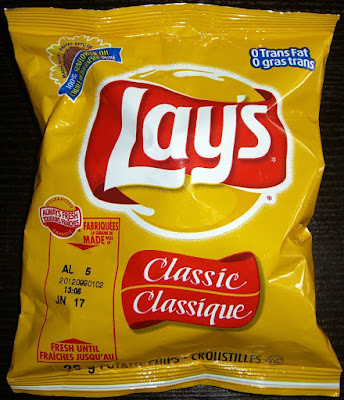


But now canny marketers are not just exercising ploys to hide bad ingredients, they're also tarting up perfectly normal foods with nonsensical superlatives. For example, from a bag of Lay's Classic Potato Chips: "Specially selected potatoes". Specially selected for what qualities? Cheapest possible production costs? Minimal nutritional value? Highest possible pesticide concentrations? Most egregious carbon footprint? I'm guessing that maybe they mean they're selecting them for something positive, but the sheer meaninglessness of the phrase compromises the intent of ingredient disclosure: to factually inform the purchaser what is in the bag.
 To expect the media to cover this trend would be naïve: they depend on the largess of corporate advertisers. To expect food merchants to properly educate the public is clearly not in their self interest. To expect politicians to do anything would be equally naïve: they won't even allow the prohibition of known poisons from food without extreme pressure, and they have campaign fundraising to worry about. The judiciary and the civil service may try to do the right thing, but they are routinely stymied. If we can't trust the labels, maybe we shouldn't buy their crappy packaged food at all.
24 Sept 2007
Why write HTML for AIR?
I was trying to figure out why anyone would want to write standards-based web pages specifically for Adobe AIR. I'm not talking about Flash/Flex or ActionScript development, I'm talking about using regular HTML, CSS and Javascript to build a website, but then shoehorning it into the Adobe Flash runtime. Why would anyone want to do this?
The stated reason is to ensure that you are providing a consistent experience across browsers and versions, the WORA promise again, but for real this time. That way you can provide the same crap user experience to all users, disabling their scroll wheel and all that great stuff that Flash provides so "richly". Gag.
No, what this is about is locking down web content: keeping people from right-clicking images and saving them, safeguarding the sacred goodies. But first and foremost: disabling Adblock to make sure the punters see the ads. Keeping the geeks from personalizing your pages with Greasemonkey, and preventing client-side mashups. As collateral damage, keeping the visually impaired or blind from using their accessibility tools. But most of all, maintaining control. Control at any cost!
It's the gospel of control that Adobe has always preached, but a way of applying it to a whole other set of technologies: the ones that have formed a generation of software that enabled freedom of choice and diversity of platforms and spurred the development of the web. Adobe's other gospel of richness means two things: your page looks rich (shiny, high in fat), and Adobe builds a monopoly and a position of control that they can monetize someday. And that would make Adobe rich.
The stated reason is to ensure that you are providing a consistent experience across browsers and versions, the WORA promise again, but for real this time. That way you can provide the same crap user experience to all users, disabling their scroll wheel and all that great stuff that Flash provides so "richly". Gag.
No, what this is about is locking down web content: keeping people from right-clicking images and saving them, safeguarding the sacred goodies. But first and foremost: disabling Adblock to make sure the punters see the ads. Keeping the geeks from personalizing your pages with Greasemonkey, and preventing client-side mashups. As collateral damage, keeping the visually impaired or blind from using their accessibility tools. But most of all, maintaining control. Control at any cost!
It's the gospel of control that Adobe has always preached, but a way of applying it to a whole other set of technologies: the ones that have formed a generation of software that enabled freedom of choice and diversity of platforms and spurred the development of the web. Adobe's other gospel of richness means two things: your page looks rich (shiny, high in fat), and Adobe builds a monopoly and a position of control that they can monetize someday. And that would make Adobe rich.
Subscribe to:
Posts (Atom)